I’m currently on a train from Dundee to London after yet another wedding yesterday. It’s that interesting time of year when the seasons are changing, but the weather has been surprisingly mild.
I’ve been thinking again about different people’s reactions to me. On the train, the train manager came to check all my assistance was booked, and at first I forgot why he was talking to me. Then I remembered that I am a wheelchair-user, so it was his job to check on me. He just spoke to me in such a normal, unpatronising way I wasn’t used to it.
Last week, I had a knock at my door on Halloween. A very little boy chirped “Trick or treat!” whilst his mum saw me in my manual wheelchair and gave a sheepish/dismayed “Oh.” I blame myself for not opening my front door very confidently, but anyhow it was still a rude reaction from the lady. I’m not even offended, I know that some people are like this, but it’s still disappointing. I’d forgotten about Halloween and didn’t have anything for them anyway. The child was oblivious, but his mum was unnecessarily apologetic. It is hardly an inconvenience for me to open the front door.
Oh well, you win some you loose some. The other week a child saw me in my powerchair and said to his friend, “Ooo, look at that car thing!” A great first impression.
—
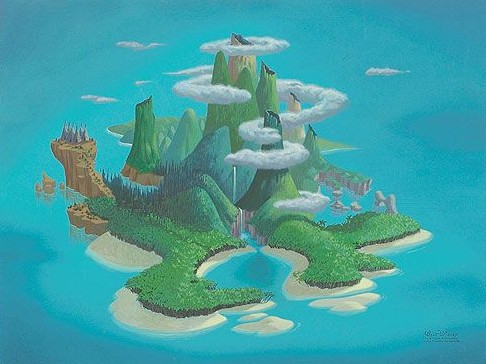
As I’ve been writing Alice in Wheelchairland this week, I’ve been reminded of the first film I saw in the cinema when I was 6. In the 2000s, Disney went through a phase of making a load of direct-to-video sequels to their classic animated films. Return to Neverland (2002) was one of the few of these sequels that got a theatre release, and is a sequel to Disney’s Peter Pan (1953). It’s obviously an average quality children’s film, but it made a deep impression on little me, and probably my gateway into reading J.M. Barrie’s 1911 original book. I’ve always been fascinated with how the story is adapted and retold over time and have since read and watched many different Peter Pan stories and used Peter Pan as the basis for my MA Dissertation. In fact, I chose the course because I knew that I somehow wanted to write about Peter Pan and looked for an MA where I could do this.
Return to Neverland is about Jane, Wendy’s daughter, and takes place during the blitz of WWII. Jane’s father is away at war and Jane holds herself responsible for being sensible and looking after the family, disapproving of her mother for filling her younger brother’s head with childish Peter Pan stories. She thinks she has no need of wonder anymore, but then Jane gets captured by Captain Hook and taken to Neverland, where she meets the real Peter Pan. Jane’s refusal to believe in “faith, trust and pixie dust” means she won’t be able to get home if she can’t believe and fly. Jane’s unbelief causes Tinker Bell to nearly die. Peter Pan is captured, and Jane has to learn to embrace the wonder in order to save the day and get home.
As you can imagine, this very existential theme of belief hit hard on an impressionable young child. I wonder how many parents pay attention to the messages being told to their children in stories. Are the plots of films and video games given less attention than books? The message I took from Return to Neverland (2002) was ‘I might go through circumstances that tempt me to stop believing. I’m a child now but I might change as a grow up, and with change comes the opportunity to believe different things.’ Jane’s ‘trust’ in the wonder is gained through experience. Return to Neverland says it is braver and wiser to believe even when bombs are falling around you.
I obviously didn’t think all this when I was 6, but when I read the lyrics of the song “I’ll Try,” I can see how I was influenced even though I’m much to big and clever to listen to a Disney movie. (Genuinely embarrassed that this film meant so much to me, but also, I shouldn’t be!). Writing for children now, I can see how my own childhood has affected how I tell stories.
—
In other news, I’ve applied to volunteer at Great Ormand Street Hospital. Funnily enough I’ve always known about them, as they are the children’s hospital that hold the rights to Peter Pan, which JM Barrie gifted on his death. I don’t quite know what I’ll be doing or the timeframe of this, but I wanted to volunteer somewhere, and thought the children’s hospital in Central London would be a good place to start. I’m sure I’ll be asked if I used to be an inpatient, which will be a funny first impression.
…
.
.
(Featured Image is a production background by John Kleber for Return to Neverland, 2002)
Discover more from Elizabeth Starr
Subscribe to get the latest posts sent to your email.

Published by
Categories: Uncategorized
Leave a Reply