I’ve been thinking a lot about creativity, and the purpose of art. Last week I had dinner with a friend who told me she had written a poem that had come third in a national competition for her community. She was very encouraged because she had never been interested in poetry, not liking the poetry they had to read in school. She doesn’t read books either but had read a lot as a child.
I said that doesn’t matter. Childhood reading builds creativity. Being creative doesn’t mean you are set in one mode of expression. Creative expression is music, drawing, dancing. I’ve heard it said that reading is breathing in and writing is breathing out. Poetry is an exhalation. It is a fact of being human to be creative, and poetry, like all art, is completely subjective and a matter of taste. Not reading as an adult, but watching narrative tv shows or listening to music is still taking in creativity. Lots of children don’t like the poems they are given at school and so grow up thinking they don’t like poetry. But everyone likes some form of art, it just depends on the style and the story.
Books are just one of the many kinds of art, and childhood reading is a way of taking in art and stories. Adulthood is when all that art and stories can be utilised for self-expression. We don’t have to be skilled at something in order to do it (Thank goodness!).
—
When I was a teenager, I started writing lyrics, and taught myself the guitar in order to accompany myself singing them. Now that I no longer play music, I can look back and see for me that time was all about the writing, working out what I wanted to say and how I was going to present it. One of the lyrics I wrote has stayed with me so much so that I am writing it into Becoming Sweetwood, “Make art out of things that you don’t understand.” When I first wrote this, I was just twisting my feelings and ideas into a narrative, turning to art things I couldn’t explain. When in rehab after being in hospital, I tried to take my own advice and started writing a blog about what happened to me which I did not understand, turning trauma into art. And now I’m working on a novel that takes trauma and fictionalises feelings for the sake of art.
I’m not saying all art is about trauma, but when you’ve been dumped with an armful of it, what else is it good for except being beaten into art? This isn’t to say that everyone should be making art, but that everyone can recognise the creativity in them which can be expressed in many different ways, not just art. Some of the most creative people I know are parents, or cooks, or handymen, and everyone knows someone who pours all their creativity into their interactions and friendships. We all have a story. The story may not always be happy, but it’s yours and no one can take that away from you. It’s your truth, as it were. But why tell the truth when you can tell a story? (I’ll let you answer that).
—
A book I’ve loved recently is Nemonte Nequimo’s 2024 We Will Not Be Saved: A memoir of hope and resistance in the Amazon rainforest, which is one indigenous tribal woman from territory in Ecuador’s powerful story of coming out from the capitalist and colonialist influence of Christian missionaries to become one of the frontline voices against the oil companies ravaging the land, partnering with her American writer husband to tell the world her story. I loved the wisdom found after her experience of trauma, and watching her grow up through her beliefs. I have included my favourite quote here:
.
I felt laughter rising in my gut.
…
“Are you going to have another laughing attack?” Michi asked.
…
I had been laughing for an entire moon. The laughter was jaguar medicine. It was what my ancestors had been trying to teach me all these years: to laugh at my own suffering, to laugh like wind in the forest, to laugh all the way into battle. It was part of my people’s power. It was our medicine. It was the mask we wore for protection, the laughter of survival.
…
Laughter is another response to trauma, like art. Of course, humour can be used as a mask to hide a deep hurt, or a mask for anger or relief, but it can also be a release of defiance, to accept the stories of the world that you have no control over. To reject bitterness and cynicism. Not to be silly and escapist, but to look at reality with clear eyes and still choose to embrace it.
…
Big words and concepts which feel too mature to be coming out of my brain, but they’re what I aspire too. Yes, you have to be aware of when it is the time to laugh and when it is the time to listen, which I am working on, but we will get there. I don’t recommend laughing into your dinner, but I do recommend listening, and then choosing when to laugh.
.
.
.
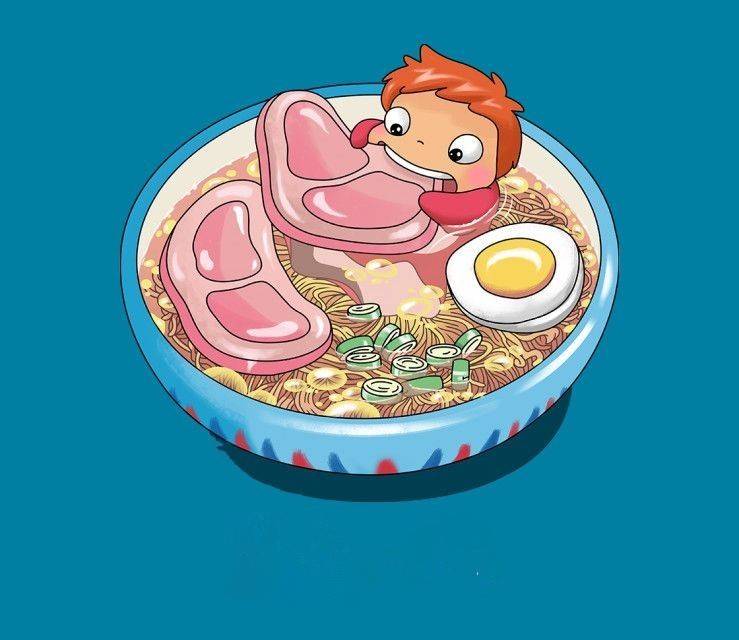
(Featured Image is ‘Noodles Swim’ by Sam Sekai, inspired by the 2008 Studio Ghibli film Ponyo)


Leave a Reply