Just before the beginning of the Easter holidays, I received some feedback on my latest draft of Becoming Sweetwood from the agent James Catchpole. Basically, he thinks the concept is very arresting, but the way it’s written feels quite hazy and memoir-y at the moment with not enough dramatic tension, which I agree with. Even though my novel is very fictional, at the moment rather than tracing an emotional arc and following clear character development, it’s written very matter-of-factually as an account of what happens. This is because, when I wrote it, I followed the structure of a year in hospital rehab, drawing on my own experience as well as other accounts I’ve read, with the tree as a metaphorical stand-in for some kind of illness/brain injury. However, I very much want this to be a fictional story based on a character and her emotional journey. I think I have shied away from making the main character have any negatives thoughts about herself, probably because I don’t want anyone to read into it and think that I am writing about myself, but I know that to make truly meaningful art you have to let go of worrying about what people might think it means. The power of art is in the fact that everyone interprets it differently.
So right now I’m going back to planning, tracking through my chapters and seeing what to add or remove. I’m working on the different character arcs of the family and seeing what themes I need to stress. I don’t want to rush it (but also don’t want to dither?)
—
It has dawned on me that the concept of people turning into sweetwood and the setting of the Sweetwood as a forest Sky wakes up in and stays in for what turns out to be a year is the thing I need to focus on the most. Sweetwood is the unique selling point of the book, and I think it is my play between the wonder of imagination versus the mundanity of reality that makes it different. The forest as a liminal space where people (children) get lost and time loses its meaning is a very common theme in fairy tales and myths. I’m sure you can easily think of stories where the forest (or natural place) is an opposite location to the regimented (calm? oppressive?) order (sense) of the domestic space. In Cartoon Saloon’s Irish animated film Wolfwalkers (2020), the straight lines of the town and its pale people are contrasted by the rounded lines and warm colours of the forest, accentuating the different locations. Forests are traditionally a place of confusion and lack of control, so it makes sense to me that one can be used to represent disability and hospitals.

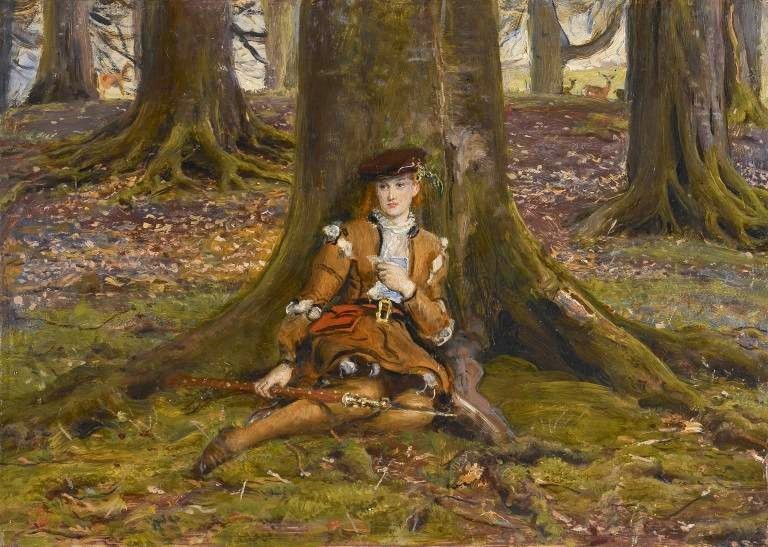
The forest I keep coming back to is the Forest of Arden, in Shakespeare’s As You Like It. In typical Shakespearen comedy fashion, As You Like It is a mix up of identies and romance, spurred on by a going into the forest, where time and sense go astray. The heroine Rosalind runs away from persecution in her uncle’s court with her friend Celia into the Forest of Arden. Arden is actually a real place in the West Midlands, though Shakespeare was also thought to be incorporating elements from the Ardennes forest in Thomas Lodge’s prose romance Rosalynde; Or, Euphues’ Golden Legacy, set in Europe. Whatever the case, the forest in As You Like It, as do natural settings in many of Shakespeare’s plays, creates the perfect location of change, for characters to get lost inside and eventually find their way out, into love and revelry. I don’t quite want to continue writing that story of joy and finding yourself in the forest what with the nuances of my brain injury metaphor, but know that I need to place more emphasis on the Sweetwood. I don’t want to romantises them, but forests are more beautiful than hospitals.
—
Becoming Sweetwood starts with Sky waking up in the forest. The inciting incident has already happened and the drive of the story is finding her way out. Part of me wants to channel a nature book of realistic description, and part of me wants to channel a magical wonderland. But this is also my chance to explore a teenager’s experiences of love, time and loss, and her changing reaction to her own change, even if they are negative at times. She is half a tree, but she is half human, which is the whole point.
(Featured image is ‘Rosalind in the Forest’ by John Everett Millais, c. 1867 – 1868)

Leave a Reply