Yesterday I sent the edited second draft of Becoming Sweetwood to James Catchpole, the literary agent I met briefly last year and liked my first draft. I have been following @thecatchpoles on Instagram for a few years now, from before my novel was written. James and Lucy were the people I was hoping the most would like Becoming Sweetwood and I vowed (Edit: not in a creepy way! A fun way) when I had written it, I would try and find a way to meet them. As it happened, James Catchpole was going to be at the Barnes Children’s Literature Festival 2022 to talk about the children’s book he had written with Lucy, You’re SO Amazing!. I volunteered at that festival because it just so happens to be next to and sponsored by Roehampton University, where I was studying my MA Children’s Literature. For those not aware, it is a literary agent who represents an author and pitches their work to publishers. The Catchpoles have written a book, but their main job is working with other authors. Working with an agent like this appeals to me because it sounds like they know a whole lot more about how the publishing industry works than me and I would love someone knowledgeable to give guidance. When we met, James said he would be happy to read my draft which surprised me because I know how many drafts agents get sent. As it happened, he read my draft and gave me his professional view that my idea was worth pursuing at the same week that the council gave me this temporary flat. As it also happens, yesterday when I sent James my second draft was when the council emailed me again for more information about finding me permanent accommodation. So more unknown ahead for me, but at least my writing is worth pursuing.
—
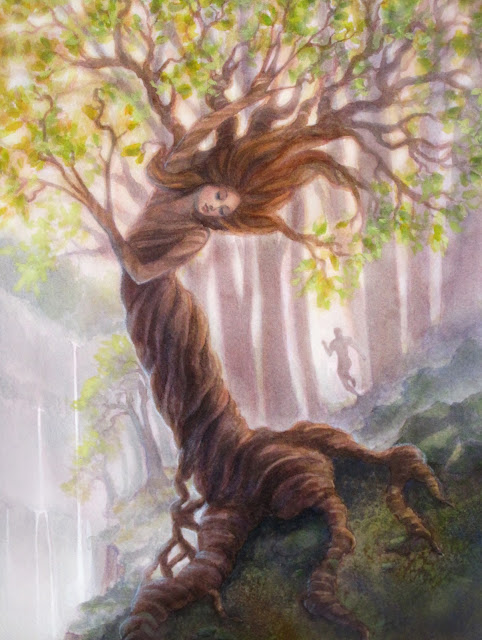
I’ve already written about how much I’ve been inspired by the ancient greek myths that were written down by the Roman poet Ovid in his 8 CE Metamorphoses. In one of the myths, Daphne the daughter of a river god is out and about when Apollo is struck by Cupid’s arrow (a handy excuse for rape if there ever was one) sees her and “falls in love” immediately. She doesn’t want this and runs away. Apollo chases her and she cries out to her dad for help. Her dad promptly turns her into a laurel tree. Apollo was so sad he made her tree evergreen so that her beauty will never fade and fashioned her leaves into a crown so she’ll always be with him. Somewhere down the line, that’s why we still have crowns of laurels today. When I made up the word ‘sweetwood’ I wasn’t intending to reference this story, but I looked up the word and apparently it is one of the names for laurel.
This was one of the many myths I read as a child that inspires my writing. It’s not something I dwelled on, but when I became Disabled very suddenly, I thought again about the ancient myths of change and realised I had so many more questions about them. The story is so sparse it doesn’t stop to tell us if it is a good thing or a bad thing that Daphne was turned into a tree? Was she punished or spared? What did she feel about it? And what do her family think about it? These have become themes in my novel.
—
James replied to my email and said he has a couple of books to read, so can I distract myself until he’s ready? Well, distracting and entertaining myself is my full time occupation – I don’t ever want to get in the mindset of wanting for my life to begin. Life is happening right now! Writing is just a fun part of that. I’m not sure what I’ll do next but I’m going to go outside and think about what I want. After all, it is a sunny day.
(Featured image is ‘Lost in Leaves’ by Pamela Goodman, 2011. The Daphne and Apollo myth is so old it has been decpicted in art so often I found it really hard to choose an image!)
Discover more from Liz Starr
Subscribe to get the latest posts sent to your email.

Published by
One response to “6. It’s Happening Now”
-
Your message made me thing that many experiences are view through the dominant lens of ‘good’ and ‘Bad’. I read the events you discuss as ‘facts’, so the ‘good; and ‘bad’ are perhaps also facts. A different lens might be ‘what is this new experience like? What do I see from this new perspective?’ It is interesting to recognise the dominance of the first lens (which is also likely have cultural influences), but then put it to one side and explore the range of other possible lenses (less affected by the good-bad emotion lens).
An illustration to the idea of subsidy lens might be “name a mountain in Eryri (Snowdonia)?” Answer: Yr Wyddfa (Snowdon). “Ok, now forget that mountain, and thing of the others.”

Leave a Reply