So, I’m in St Pancras again, waiting to get the train back to Leicester for Christmas. I had one of my favourite encounters on the bus this morning. As I was going up the ramp, an old lady said something like “I’ll help you!” and her friend joined in with “Come on, let’s do it together!” and they both pushed the back of my chair into the bus. One even exclaimed in amazement how she was doing it one handed. My friends, my powerchair is electric. It can’t be pushed. I’m doing all this.
What is the word for finding something sweet-but-nevertheless-annoying? I don’t get bothered by older people who assume I need help. Ladies, I wouldn’t be out and about if I didn’t know what I was doing, but I appreciate your concern. And sometimes access does make me nervous. Later on I took the tube and the gap between the train and the platform was larger than I was expecting. I hesitated and two men coming onto the train instantly offered help and fluidly lifted up the front of my chair over the gap and continued on their way. That kind of automatic assistance happens all the time and I’m alright with it, I don’t have time to worry about it. Of course I’d rather be independent, but I have nothing to prove, I have places to go. When I was getting off the train the gap was also bigger than what I was expecting, but even though someone offered help I closed my eyes and went for it. Turns out my powerchair could make that gap. I guess it all depends on if you know the limits of what you can do, which you’ll only learn through experience. I try and forward plan like all good Disabled people, but I also like to learn on the go. When I moved to London two years ago I didn’t really understand how to get around, and I’m still very much learning. At the start my parents were driving me down to drop me off with my manual wheelchair which I use in my flat, but after a while of this I bought another manual wheelchair to leave at their house with my old one at my flat so I could take the train between the two places with my powerchair (that’s the word for electric wheelchair). I can do it myself.
—
I recently watched CBBC’s 2018 television series Katy, based on a 2015 novel Jacqueline Wilson wrote based on the 1872 children’s classic What Katy Did by Susan Coolidge. Anyone who read the original as a child has no doubt forgotten the (frankly ludicrous to 21 century readers) plot where spirited girl Katy falls and “bruises her spine” and becomes bed bound, staying in her room for 4 years undergoing character development until she becomes able to walk again. For anyone who knows about what it feels like to not be able to walk, this plot is not very satisfying. Wikipedia says that Jacqueline Wilson loved the book What Katy Did, but when she reread it as an adult she “noticed the moral was not appropriate for today’s generation” and the book she wrote is about Katy becoming a full-time wheelchair-user. I read the original book along with other children’s book classics like Heidi and The Secret Garden which feature children leaving their wheelchair behind as they learn to walk again to see what I thought in preparation for my MA Children’s Literature. I have mixed feelings about them. I know what the authors were trying to do in those stories which I don’t have time to explain and it is a reality that a lot of children do learn how to walk again, but also a lot don’t. Rather than accuse individual stories we need to look at the trends in how stories for children approached disability. The stereotypical narrative in the past was of a improved mobility/health linked with spiritual learning. Simply put, bodies reflect morals. I wrote a whole dissertation basically pointing the finger at this conclusion.
What Katy does, in both adaptations, is to show audiences a realistic story of what it can feel like to become Disabled as a child. The original What Katy Did is full of advice and Christian teaching mainly told to Katy by a (typically for the period) saint-like ill person called Helen. Jacqueline Wilson re-imagines Helen as an experience wheelchair-user who comes to talk to Katy. The spirituality has been taken out of the story in favour of Katy’s conflicting emotions about being Disabled. In the CBBC adaptation, they don’t have enough screen time to develop Helen’s role, and instead she is cast as a wheelchair-using physio in the hospital Katy is in. My favourite line was when Helen encouraged Katy to try to get stronger because “the world is waiting for you.”
I heard this line in a more recent story about disability, the 2023 play The Little Big Things, a musical adaptation of Henry Fraser’s memoir, an artist who broke his neck at 17 and his whole life changed as he became tetraplegic. I read the book after watching the play and was really interested in all the changes they made to fictionalise the story, including adding a wheelchair-using physio. I really liked the sentiment of the song “The Little Big Things,” which is about being grateful for the small things in life, but the song which made me the most emotional was sung when Henry had just got out of hospital, called “The World Is Waiting For You.” That’s what I want to say to anyone who has become Disabled too. It will take a lot of time to get used to who you are and there will be times when you feel very sad. But you are not alone.
—
At the moment I’m waiting til after the holidays to edit my book again. I’ve already been through it twice and want to leave some space between edits to give myself more time to think. I’m in touch with a literary agent who read my first draft, and he is happy to read what I’ve done in the new year.
My aim with Sky in Becoming Sweetwood is to create a protagonist who doesn’t panic or hate herself when she becomes disabled. Jacqueline Wilson’s Katy is set in the “real world” and Katy’s emotions towards disability are negative for most (all?) of the book. This is realistic for the character, and I want to create a contract to her. That’s not to say I want to write an annoyingly positive character instead, but Becoming Sweetwood is fantasy, and so a metaphor. As such Sky is less of a real person and more of an idea of what to be like. She never gets to grappling with the real world like Katy but maybe she’ll be an idea in the heads of readers who will.
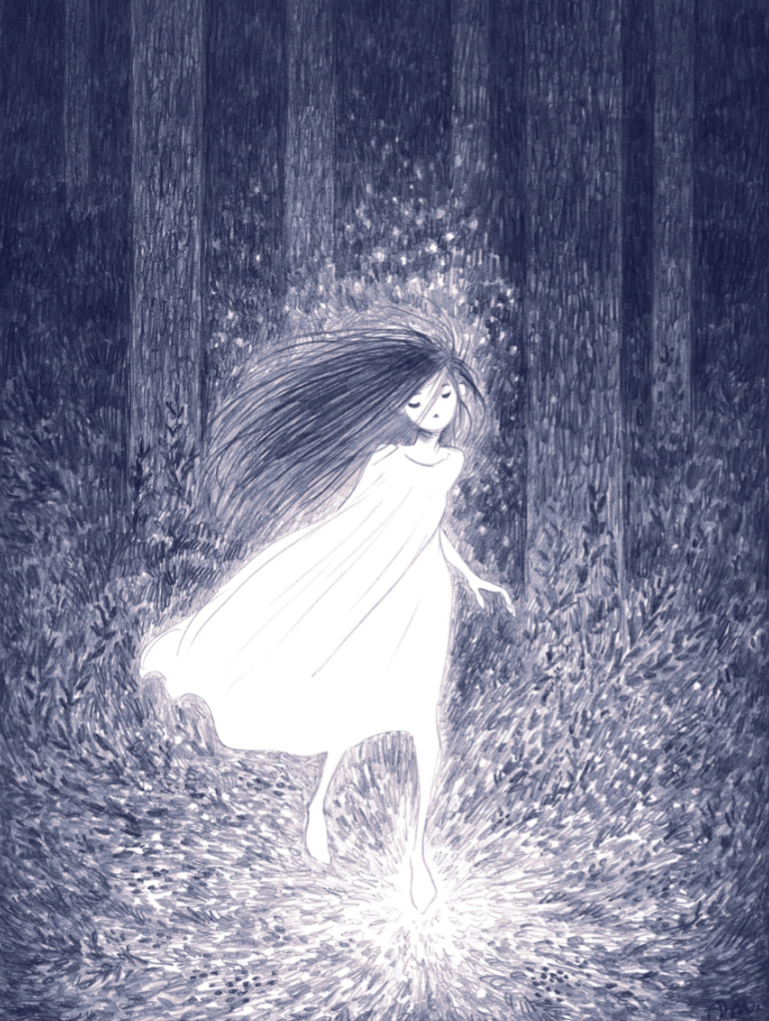
(Featured image is ‘Step of Light’ by Paula Mela, 2021)
Discover more from Liz Starr
Subscribe to get the latest posts sent to your email.

Published by
Categories: Uncategorized
One response to “4. The World Is Waiting For You”
-
Really enjoy reading your blogs. My sister had MS and used a wheelchair for many years. We know about the frustrations of lack of ramps etc.. Probably accessibility has improved in the last decade, but still needs a lot of determination and courage to negotiate London!

Leave a Reply